DevOps vs Traditional IT – What is the Difference?
The IT industry has undergone a massive transformation over the last decade. Traditional IT practices that once dominated software development and infrastructure management are rapidly being replaced by modern DevOps methodologies. Organizations today demand faster deployments, automation, scalability, and continuous delivery — something Traditional IT struggles to achieve efficiently.
Understanding DevOps vs Traditional IT is essential for students, IT professionals, and career switchers planning to enter the modern technology landscape. This article explains the fundamental differences between DevOps and Traditional IT, how they impact businesses, and why learning DevOps has become a critical career move in 2026.
For more information. Click here lavatechtechnology.com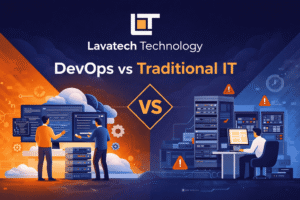
What is Traditional IT?
Traditional IT refers to the conventional approach to managing software development, infrastructure, and operations. In this model, development and operations teams work in silos, each handling separate responsibilities. Developers write code and pass it to operations teams, who deploy and maintain systems.
This separation often leads to slower releases, communication gaps, and increased failure rates. Traditional IT focuses heavily on stability and manual processes, which worked well when software updates were infrequent.
However, in today’s fast-moving digital environment, businesses require rapid innovation and frequent deployments — exposing the limitations of Traditional IT.
What is DevOps?
DevOps is a modern IT approach that integrates development and operations teams into a collaborative workflow. It emphasizes automation, continuous integration, continuous delivery (CI/CD), monitoring, and rapid deployment.
Instead of working in isolation, DevOps teams collaborate throughout the software lifecycle — from planning and coding to deployment and maintenance. Automation tools like CI/CD pipelines, containerization, and cloud infrastructure enable organizations to release software faster and more reliably.
This shift from Traditional IT to DevOps has transformed how companies build and manage technology systems.
DevOps vs Traditional IT: Key Differences
1. Team Structure
Traditional IT teams operate in silos — developers build software and operations teams deploy it. This separation often causes delays and blame culture.
In DevOps, teams collaborate throughout the lifecycle. Developers and operations engineers share responsibilities, improving communication and accountability.
2. Deployment Speed
Traditional IT follows long release cycles. Software updates may take weeks or months.
DevOps enables continuous integration and continuous deployment (CI/CD), allowing frequent releases — sometimes multiple times a day.
3. Automation
Traditional IT relies heavily on manual configuration, testing, and deployment processes.
DevOps prioritizes automation across pipelines, infrastructure, and monitoring, reducing human error and increasing efficiency.
4. Infrastructure Management
Traditional IT uses static infrastructure managed manually by administrators.
DevOps uses Infrastructure as Code (IaC), cloud platforms, and containerization, enabling scalable and repeatable environments.
5. Risk and Reliability
Traditional IT changes are large and infrequent, making failures costly and difficult to fix.
DevOps promotes small, frequent changes with automated testing and monitoring, reducing risk and improving system reliability.
6. Business Alignment
Traditional IT often operates separately from business goals.
DevOps aligns IT with business objectives by enabling faster feature delivery and customer-centric development.
7. Career Opportunities
Traditional IT roles are declining in demand due to automation and cloud adoption.
DevOps professionals are among the most in-demand IT experts in 2026, with strong salaries and global opportunities.
Why Companies Are Moving from Traditional IT to DevOps
Modern businesses compete in digital markets where speed and innovation determine success. Customers expect frequent updates, reliable applications, and seamless user experiences.
DevOps helps organizations achieve:
Faster product releases
Higher system reliability
Scalable infrastructure
Reduced operational costs
Improved collaboration
These advantages explain why DevOps vs Traditional IT adoption is growing across industries like banking, e-commerce, healthcare, and SaaS.
Why Learning DevOps is Essential in 2026
Understanding DevOps vs Traditional IT is not just theoretical — it directly impacts career growth. Companies today prefer professionals skilled in:
Cloud (AWS)
CI/CD pipelines
Monitoring & automation
Traditional IT knowledge alone is no longer sufficient in modern environments. DevOps vs Traditional IT skills make professionals job-ready for cloud-native and automated infrastructure roles.
Learn DevOps with Lavatech Technology
As organizations shift from Traditional IT to DevOps, professional training becomes essential. Lavatech Technology provides industry-focused DevOps training designed for beginners, graduates, and working professionals.
The program covers real-world tools including Linux, AWS, Docker, Kubernetes, CI/CD, and Infrastructure as Code. Students gain practical experience through live projects and deployment scenarios aligned with industry needs.
This hands-on approach helps learners transition from Traditional IT concepts to modern DevOps practices effectively.
Conclusion
The debate of DevOps vs Traditional IT clearly shows how IT has evolved from slow, silo-based operations to fast, automated, and collaborative environments. While Traditional IT laid the foundation for enterprise systems, DevOps has become the standard for modern software delivery.
For anyone planning a career in IT in 2026, understanding DevOps is no longer optional — it is essential. Professionals who adopt DevOps practices gain better career opportunities, higher salaries, and future-ready skills.
As companies continue digital transformation, DevOps will remain the dominant IT model shaping the future of technology careers.
For more information. Click here lavatechtechnology.com
Call us on +91 9607331234