DevOps for Beginners
🚀 DevOps: The Complete Guide for Beginners to Build a Successful IT Career
Introduction
In today’s technology-driven world, businesses demand faster software delivery, better quality, and seamless user experiences. Traditional development methods often fail to meet these expectations due to slow processes and lack of collaboration.
This is where DevOps comes into the picture.
DevOps has become one of the most in-demand skills in the IT industry, offering exciting career opportunities for beginners and professionals alike. Whether you are a student, fresher, or working professional, learning DevOps can open doors to high-paying and future-proof roles.
DevOps for Beginners
What is DevOps?
DevOps is a combination of Development (Dev) and Operations (Ops). It is a set of practices that brings together software developers and IT operations teams to improve collaboration and automate workflows.
The main goal of DevOps is to:
- Deliver software quickly
- Improve product quality
- Reduce errors and downtime
- Enhance team collaboration
Instead of working separately, development and operations teams work together throughout the software lifecycle.
Why is DevOps Important?
DevOps plays a crucial role in modern IT environments. Here’s why it matters:
1. Faster Software Delivery
Companies can release updates and new features quickly using automation and continuous integration.
2. Better Collaboration
DevOps breaks down communication barriers between teams, leading to better efficiency.
3. Improved Quality
Continuous testing helps identify bugs early, ensuring high-quality applications.
4. High Demand in Job Market
DevOps engineers are among the most sought-after professionals in the IT industry.
5. Scalability
DevOps allows businesses to scale applications easily using cloud technologies.
DevOps for Beginners
Key Concepts in DevOps
To understand DevOps better, you need to learn its core concepts:
Continuous Integration (CI)
Developers frequently merge code into a shared repository, where automated testing is performed.
Continuous Delivery (CD)
Code changes are automatically prepared for release, ensuring faster deployment.
Infrastructure as Code (IaC)
Infrastructure is managed using code, making it easy to automate and scale systems.
Monitoring and Logging
Real-time monitoring helps detect and fix issues quickly.
Automation
Automation reduces manual work and improves efficiency.
DevOps for Beginners
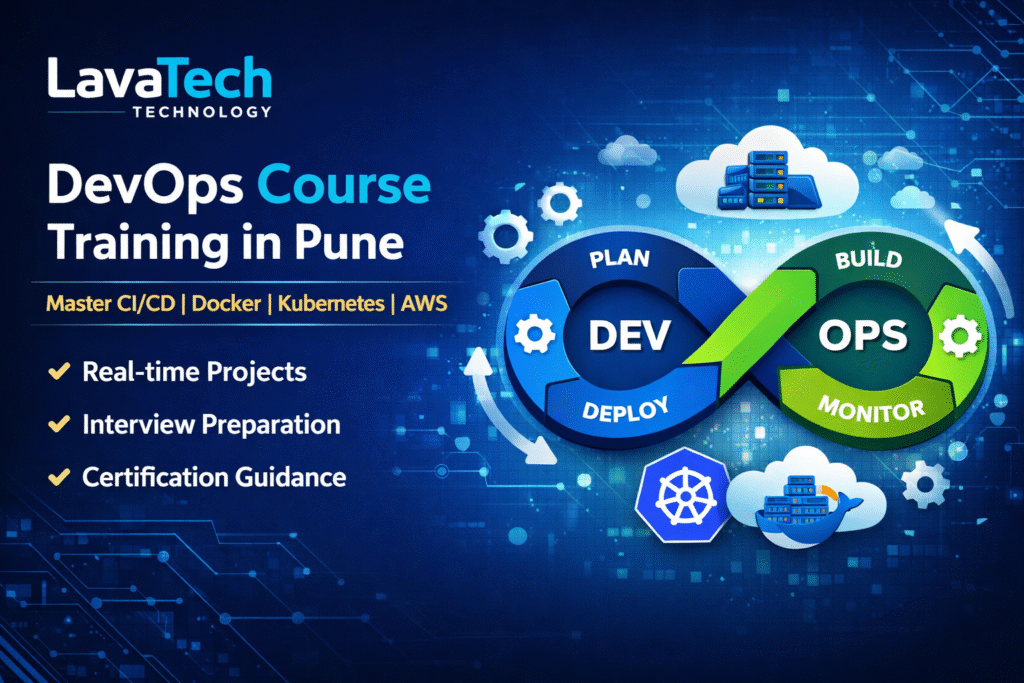
DevOps Lifecycle
DevOps follows a continuous cycle that includes:
1. Planning
Defining project requirements and workflow.
2. Development
Writing and managing code using version control systems.
3. Building
Compiling and packaging the application.
4. Testing
Running automated tests to ensure quality.
5. Deployment
Releasing the application to production.
6. Monitoring
Tracking performance and identifying issues.
7. Feedback
Using insights to improve future development.
Popular DevOps Tools
DevOps uses various tools to automate processes and improve productivity:
Version Control Tools
- Git
- GitHub
CI/CD Tools
- Jenkins
- GitHub Actions
Containerization Tools
- Docker
Orchestration Tools
- Kubernetes
Configuration Management
- Ansible
- Puppet
Monitoring Tools
- Prometheus
- Grafana
Learning these tools is essential for building a strong DevOps career.
DevOps for Beginners
Career Opportunities in DevOps
DevOps offers excellent career opportunities with high salaries. Some popular job roles include:
- DevOps Engineer
- Cloud Engineer
- Site Reliability Engineer (SRE)
- Automation Engineer
- Build and Release Engineer
💰 Salary Insight (India)
- Freshers: ₹4–8 LPA
- Experienced professionals: ₹10–25+ LPA
With the right skills and training, you can quickly grow in this field.
Skills Required to Learn DevOps
To become a successful DevOps engineer, you need:
Technical Skills
- Linux fundamentals
- Networking basics
- Cloud platforms (AWS, Azure, GCP)
- Scripting (Python, Bash)
Soft Skills
- Problem-solving
- Communication
- Team collaboration
Why Learn DevOps from a Training Institute?
While self-learning is possible, joining a professional training institute offers several advantages:
Structured Learning Path
You get a clear roadmap from beginner to advanced level.
Hands-on Projects
Practical experience is essential in DevOps, and institutes provide real-time projects.
Expert Guidance
Learn from industry professionals with real-world experience.
Placement Support
Many institutes provide job assistance and interview preparation.
DevOps for Beginners
Future of DevOps
The future of DevOps is bright and evolving rapidly. Some emerging trends include:
- AI in DevOps (AIOps)
- DevSecOps (Security integration)
- Serverless Computing
- Cloud-native development
As businesses continue to adopt digital transformation, the demand for DevOps professionals will keep growing.
DevOps for Beginners
Conclusion
DevOps is not just a technology—it’s a career opportunity and a powerful approach to modern software development. It helps organizations deliver better products faster while improving efficiency and collaboration.
For students and professionals looking to enter the IT industry or upgrade their skills, DevOps is one of the best career choices today. With the right training, hands-on experience, and dedication, you can build a successful and rewarding career in this field.
DevOps for Beginners
🎯 Start Your DevOps Journey Today
If you’re ready to build a career in DevOps:
- Start learning the basics
- Practice with real tools
- Work on projects
- Join a professional training program
👉 The sooner you start, the faster you grow