DevOps Coaching in Pune: 7 Powerful Career Benefits of Learning at Lavatech Technology
DevOps is a practice that combines development and operations to build, test and release software faster and more reliably. It focuses on automation, collaboration and continuous delivery to improve software quality and speed.
- Helps teams release software faster with automation
- Reduces manual errors and improves reliability
- Enables continuous integration and deployment
- Improves collaboration between development and operations teams
DevOps Coaching in Pune: Build a High-Paying IT Career with Lavatech Technology
The demand for skilled DevOps professionals is growing rapidly across India and globally. Companies are actively searching for engineers who can automate deployment, manage cloud infrastructure, and improve software delivery processes. If you want to enter the IT industry or upgrade your technical skills, enrolling in the best DevOps coaching in Pune can be a game-changing decision.
At Lavatech Technology, students receive industry-oriented DevOps training designed to help beginners and professionals become job-ready. From cloud computing to automation tools, the course focuses on practical learning, live projects, and placement-oriented training.
Whether you are a fresher, software developer, system administrator, or cloud enthusiast, this training program can help you build a rewarding career in DevOps engineering.
What is DevOps?
DevOps is a combination of “Development” and “Operations.” It is a modern software development approach that improves collaboration between developers and IT operations teams. The goal is to automate processes, improve software quality, and deliver applications faster.
Today, almost every technology company uses DevOps practices to:
- Increase productivity
- Automate deployments
- Improve software delivery speed
- Reduce downtime
- Enhance scalability and security
This is why DevOps engineers are among the highest-paid professionals in the IT industry.
Why Choose DevOps Coaching in Pune?
Pune is one of India’s fastest-growing IT hubs with thousands of software companies, startups, and multinational corporations. Learning from a professional DevOps coaching in Pune gives students access to excellent job opportunities and practical exposure.
Benefits of Learning DevOps in Pune
1. Strong IT Job Market
Pune has leading IT companies that regularly hire DevOps engineers, AWS professionals, and cloud administrators.
2. High Salary Opportunities
DevOps professionals earn attractive salary packages due to high industry demand.
3. Career Growth
DevOps skills open opportunities in:
- Cloud Computing
- Site Reliability Engineering
- Automation Testing
- Infrastructure Engineering
- Kubernetes Administration
4. Practical Learning Environment
Pune’s training ecosystem provides exposure to live projects and real-world implementation.
Why Lavatech Technology is the Best Choice for DevOps Coaching in Pune
Lavatech Technology focuses on practical and career-oriented training. The institute helps students gain real-time experience with industry-standard DevOps tools and technologies.
Key Highlights of Lavatech Technology
Industry-Experienced Trainers
Learn directly from professionals working on real DevOps projects.
Hands-On Practical Sessions
Students work on live projects and deployment environments instead of only theoretical concepts.
Placement Assistance
Lavatech Technology provides resume building, interview preparation, and job support.
Beginner-Friendly Training
The course is designed for both beginners and working professionals.
Updated Course Curriculum
The syllabus includes the latest DevOps tools and cloud technologies used in the industry.
Tools Covered in DevOps Coaching in Pune
At Lavatech Technology, students learn popular DevOps tools used by top companies worldwide.
Linux Administration
Linux is the foundation of DevOps infrastructure management.
Git and GitHub
Learn version control and collaborative development workflows.
Jenkins
Understand CI/CD pipelines and deployment automation.
Docker
Learn containerization and application deployment.
Kubernetes
Master container orchestration and cluster management.
AWS Cloud
Gain practical knowledge of cloud infrastructure and services.
Terraform
Learn Infrastructure as Code (IaC) automation.
Ansible
Understand configuration management and automation.
Monitoring Tools
Work with tools like Prometheus and Grafana for monitoring applications and servers.
Who Can Join DevOps Coaching in Pune?
This course is suitable for:
- Freshers
- IT graduates
- Software developers
- System administrators
- Cloud professionals
- Network engineers
- Technical support engineers
Even students without coding experience can start learning DevOps with proper guidance.
Career Opportunities After DevOps Training
Completing professional DevOps coaching in Pune can help you apply for multiple high-demand job roles.
Popular Job Roles
- DevOps Engineer
- AWS Cloud Engineer
- Linux Administrator
- Kubernetes Engineer
- Site Reliability Engineer
- Build and Release Engineer
- Automation Engineer
- Cloud Support Engineer
Average Salary of DevOps Professionals
DevOps professionals receive impressive salary packages depending on skills and experience.
| Experience Level | Average Salary |
|---|---|
| Fresher | ₹4 LPA – ₹6 LPA |
| Mid-Level | ₹8 LPA – ₹15 LPA |
| Experienced | ₹20 LPA+ |
The salary potential continues to increase with expertise in AWS, Kubernetes, and automation technologies.
Why DevOps is the Future of IT
Modern companies want faster software delivery, secure infrastructure, and scalable systems. DevOps helps organizations achieve all these goals efficiently.
As businesses continue adopting:
- Cloud Computing
- Artificial Intelligence
- Automation
- Microservices Architecture
the need for skilled DevOps engineers will continue growing rapidly.
This makes DevOps one of the safest and most future-proof careers in the technology industry.
Features of DevOps Coaching at Lavatech Technology
Real-Time Project Training
Students work on industry-level deployment projects.
Flexible Batches
Weekday and weekend batches are available.
Interview Preparation
Mock interviews and technical guidance improve confidence.
Certification Support
Students receive training aligned with industry certification standards.
Affordable Fees
Quality training is offered at student-friendly pricing.
Tips to Become a Successful DevOps Engineer
Practice Daily
Hands-on practice is essential for mastering DevOps tools.
Learn Cloud Platforms
AWS and Azure knowledge improve job opportunities.
Build Real Projects
Practical implementation increases confidence and technical skills.
Stay Updated
DevOps technologies evolve rapidly, so continuous learning is important.
Why Students Prefer Lavatech Technology
Students choose Lavatech Technology because of:
- Experienced trainers
- Practical learning methods
- Career-focused training
- Industry-standard curriculum
- Placement guidance
- Supportive learning environment
The institute focuses on helping students gain real-world skills that companies actively seek during recruitment.
Final Thoughts
If you want a successful IT career with excellent salary growth and future opportunities, enrolling in professional DevOps coaching in Pune is a smart decision. DevOps has become one of the most in-demand technologies in today’s software industry.
Lavatech Technology provides practical, hands-on, and job-oriented training that helps students build strong technical expertise and confidence. With expert mentorship, real-time projects, and placement support, students can prepare themselves for rewarding DevOps careers.
Start your DevOps journey today and unlock exciting career opportunities with Lavatech Technology.
FAQs – DevOps Coaching in Pune
1. Who can join DevOps coaching in Pune?
Anyone interested in IT, cloud computing, automation, or software development can join DevOps training.
2. Is DevOps good for freshers?
Yes, DevOps is an excellent career option for freshers because demand is growing rapidly.
3. What is the duration of DevOps training?
Most DevOps courses take around 3 to 6 months depending on the curriculum.
4. Does Lavatech Technology provide placement assistance?
Yes, students receive interview preparation and placement support.
5. Which tools are included in DevOps training?
Linux, Git, Jenkins, Docker, Kubernetes, AWS, Terraform, and Ansible are commonly covered.
6. What is the average salary of a DevOps engineer?
Freshers can earn around ₹4–6 LPA, while experienced professionals can earn much higher salaries.
7. Why choose Lavatech Technology for DevOps coaching in Pune?
Lavatech Technology offers practical training, expert guidance, real-time projects, and placement-focused learning.
The DevOps Lifecycle is a continuous, looping process that bridges the gap between software development (Dev) and IT operations (Ops). Unlike traditional models where development and operations were siloed steps, DevOps integrates them into a single, infinite loop of collaboration, automation, and feedback.
Phases of DevOps Lifecycle
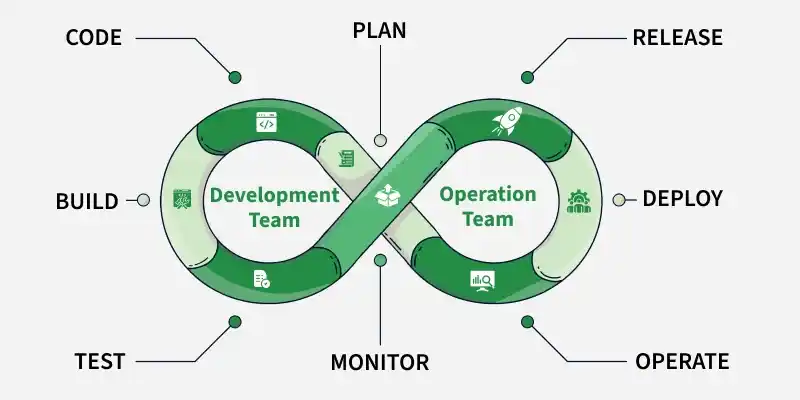
Phase 1: Plan (Dev)
Before a single line of code is written, the team must define the value they are creating.
- Goal: Define requirements, create roadmaps, and organize tasks.
- Key Activities: Backlog management, sprint planning, user story creation.
- Tools: Jira, Trello, Azure Boards.
Phase 2: Code (Dev)
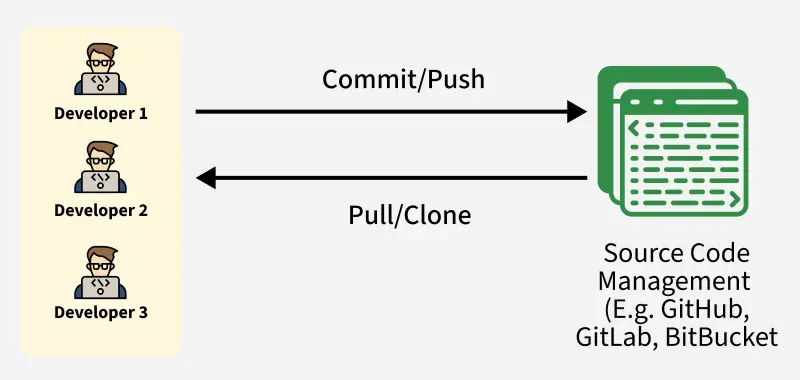
Developers write the code and commit it to a shared repository.
- Goal: Write high-quality, version-controlled code.
- Key Activities: Coding, code reviews, merging branches.
- Tools: Git, GitHub, GitLab, Bitbucket.
Phase 3: Build (Dev)
Once code is committed, it is pulled and compiled into an executable format.
- Goal: Detect compilation errors early and package the application.
- Key Activities: Compiling code, dependency management, creating container images (Docker).
- Tools: Maven, Gradle, Docker, Packer.
Phase 4: Test (Dev)
The build is tested for bugs, security vulnerabilities, and performance issues.
- Goal: Ensure software quality and prevent bugs from reaching production.
- Key Activities: Unit testing, integration testing, static code analysis.
- Tools: Selenium, JUnit, SonarQube, TestNG.
Phase 5: Release (Ops)
The code has passed testing and is ready to be deployed. This phase manages the versioning and approval.
- Goal: Schedule and manage the release to specific environments (Staging/Prod).
- Key Activities: Artifact versioning, change management approvals.
- Tools: Jenkins, GitLab CI, CircleCI.
Phase 6: Deploy (Ops)
The application is pushed to the production servers.
- Goal: Deliver the software to end-users with zero downtime.
- Key Activities: Infrastructure provisioning (IaC), configuration management, blue/green deployments.
- Tools: Terraform, Ansible, Kubernetes (ArgoCD), AWS CodeDeploy.
Phase 7: Operate (Ops)
The software is live. This phase involves the day-to-day management of the infrastructure running the app.
- Goal: Ensure system uptime and reliability.
- Key Activities: Server patching, auto-scaling, database management.
- Tools: Chef, Puppet, PowerShell, Ansible.
Phase 8: Monitor (Ops)
Data is collected from the live application to understand user behavior and system performance. This feedback loops back into the Plan phase.
- Goal: Detect issues immediately and gather insights for future improvements.
- Key Activities: Log analysis, performance tracking, alerting.
- Tools: Prometheus, Grafana, Nagios, ELK Stack (Elasticsearch, Logstash, Kibana).
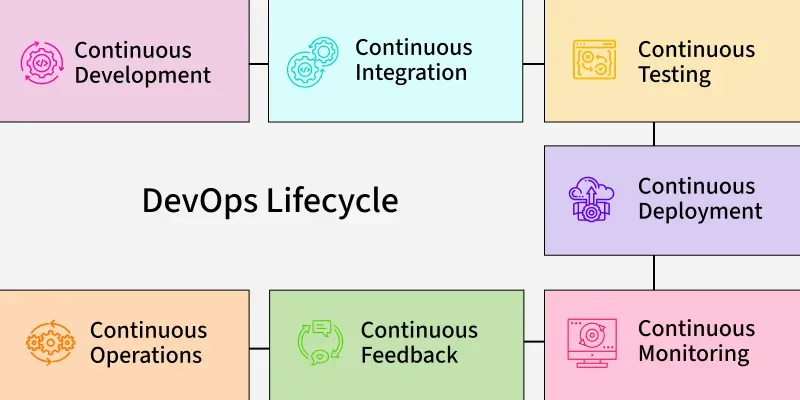
7 Cs of DevOps
The 7 Cs of DevOps are core principles that help make DevOps successful. They guide how teams work together, build, test, and deliver software faster and more reliably. Each of these Cs contributes to a workflow that enhances the quality, speed, and reliability of delivering software products:
- Continuous Development
- Continuous Integration
- Continuous Testing
- Continuous Deployment/Continuous Delivery
- Continuous Monitoring
- Continuous Feedback
- Continuous Operations
1. Continuous Development
This stage focuses on the iterative planning and coding of software in small, manageable units. It allows for rapid updates and early bug detection.
- Focus: Version control and incremental coding.
- Example: A developer builds a “Login” feature on Monday and “Search” on Tuesday, rather than waiting weeks to finish the entire app.
DevOps coaching in PuneDevOps coaching in PuneDevOps coaching in PuneDevOps coaching in PuneDevOps coaching in PuneDevOps coaching in PuneDevOps coaching in PuneDevOps coaching in PuneDevOps coaching in PuneDevOps coaching in PuneDevOps coaching in PuneDevOps coaching in PuneDevOps coaching in PuneDevOps coaching in PuneDevOps coaching in Pune