The IT industry is rapidly adopting cloud technologies, automation tools, and modern software deployment practices. As organizations focus on faster application delivery and infrastructure automation, the demand for DevOps professionals continues to rise. Companies across various industries are actively seeking skilled engineers who can manage cloud environments, automate workflows, and improve software delivery pipelines.
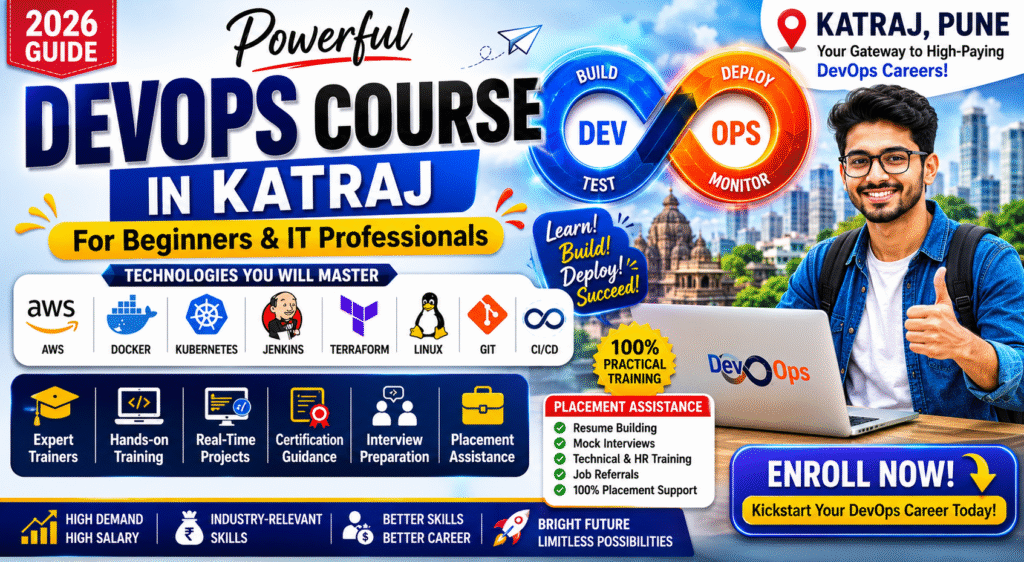
If you are looking to build a successful career in cloud computing and automation, enrolling in a DevOps Course in Katraj can be one of the smartest career decisions in 2026. Whether you are a beginner exploring IT opportunities or an experienced professional aiming to upgrade your skills, DevOps training provides a strong foundation for long-term career growth.
Why Choose a DevOps Course in Katraj?
Katraj has become a preferred destination for students and professionals seeking quality technical education. Its proximity to Pune’s major IT hubs makes it an ideal location for learning industry-relevant technologies.
Benefits of Joining a DevOps Course in Katraj
- Industry-focused curriculum
- Hands-on practical training
- Real-time project experience
- Expert trainer guidance
- Interview preparation
- Placement assistance
- Flexible batch timings
- Certification support
A professional DevOps Course in Katraj ensures learners gain practical skills that align with current industry demands.
What is DevOps?
DevOps is a combination of Development and Operations. It is a methodology that promotes collaboration between software development and IT operations teams to automate and improve software delivery processes.
Objectives of DevOps
- Faster software releases
- Improved collaboration
- Continuous Integration (CI)
- Continuous Deployment (CD)
- Infrastructure Automation
- Better application quality
- Reduced deployment failures
DevOps enables organizations to deliver software more efficiently while maintaining reliability and scalability.
Who Can Join a DevOps Course in Katraj?
A DevOps training program is suitable for:
Beginners
Students and fresh graduates can start learning DevOps from foundational concepts such as Linux, networking, and cloud computing.
Working Professionals
Software developers, system administrators, testers, and network engineers can enhance their skills and transition into DevOps roles.
IT Professionals
Experienced professionals can learn advanced cloud and automation technologies to accelerate career growth.
Technologies Covered in a DevOps Course in Katraj
A comprehensive training program includes the most widely used DevOps tools and technologies.
Linux Administration
Linux is the backbone of most cloud and DevOps infrastructures.
Topics Covered
- Linux Commands
- File Management
- User Administration
- Process Management
- Networking
- Shell Scripting
Strong Linux skills are essential for every DevOps engineer.
Git and GitHub
Git helps teams manage source code and collaborate effectively.
Modules Included
- Version Control
- Repository Management
- Branching Strategies
- Merging
- Pull Requests
- GitHub Collaboration
Git is one of the most important tools in DevOps workflows.
AWS Cloud Training
Amazon Web Services (AWS) is the leading cloud platform used by organizations worldwide.
AWS Services Covered
- EC2
- S3
- IAM
- VPC
- CloudWatch
- Route 53
- Auto Scaling
- Load Balancer
- RDS
AWS expertise is highly valuable in the cloud computing industry.
Docker Training
Docker enables containerization, allowing applications to run consistently across different environments.
Docker Topics
- Docker Installation
- Images and Containers
- Docker Compose
- Networking
- Volumes
- Deployment Strategies
Docker has become an essential technology in modern DevOps environments.
Kubernetes Training
Kubernetes is the most popular platform for container orchestration.
Topics Covered
- Pods
- Deployments
- Services
- ConfigMaps
- Secrets
- Namespaces
- Ingress
- Cluster Administration
Kubernetes skills are highly demanded in cloud-native organizations.
Jenkins CI/CD
Jenkins automates software building, testing, and deployment.
Jenkins Modules
- Installation and Configuration
- Pipeline Creation
- Build Automation
- Continuous Integration
- Continuous Deployment
- Plugin Management
Jenkins helps teams accelerate software delivery.
Terraform
Terraform enables Infrastructure as Code (IaC), allowing cloud resources to be managed through code.
Terraform Topics
- Providers
- Resources
- Variables
- Modules
- State Management
- Infrastructure Automation
Terraform simplifies cloud infrastructure deployment and management.
Real-Time Projects Included
Practical learning is one of the most important aspects of a successful DevOps Course in Katraj.
Project 1: AWS Infrastructure Deployment
Build and manage scalable cloud environments.
Project 2: Jenkins CI/CD Pipeline
Create automated software deployment pipelines.
Project 3: Docker Containerization
Containerize applications for efficient deployment.
Project 4: Kubernetes Application Deployment
Deploy and manage applications in Kubernetes clusters.
Project 5: Terraform Automation
Automate cloud resource provisioning using Infrastructure as Code.
These projects help learners gain practical experience and improve employability.
Placement Assistance and Interview Preparation
A major advantage of joining a professional DevOps training program is career support.
Placement Assistance Includes
- Resume Building
- LinkedIn Profile Optimization
- Mock Interviews
- Technical Assessments
- HR Interview Preparation
- Career Counseling
- Job Referrals
These services help students confidently prepare for job opportunities.
Common DevOps Interview Questions
Linux
- What is a Linux process?
- Explain file permissions.
Git
- What is Git Rebase?
- Difference between Merge and Rebase?
Docker
- Difference between Docker Image and Container?
- What is Docker Compose?
Kubernetes
- What is a Pod?
- Explain Kubernetes Deployment.
AWS
- What is EC2?
- What is Auto Scaling?
Jenkins
- What is CI/CD?
- Explain Jenkins Pipeline.
Terraform
- What is Infrastructure as Code?
- What is Terraform State?
Preparing for these questions helps students perform better in interviews.
Career Opportunities After Completing a DevOps Course
After completing a DevOps Course in Katraj, students can apply for various high-demand roles.
Popular Job Roles
- DevOps Engineer
- AWS Cloud Engineer
- Site Reliability Engineer (SRE)
- Platform Engineer
- Infrastructure Engineer
- Automation Engineer
- Cloud Support Engineer
- Linux Administrator
- Build and Release Engineer
The increasing adoption of cloud technologies continues to create strong demand for these roles.
Why Choose Lavatech Technology for DevOps Training?
Lavatech Technology provides practical and industry-oriented DevOps training designed to help learners become job-ready.
Key Benefits
- Experienced Trainers
- Real-Time Projects
- AWS, Docker, Kubernetes & Jenkins Training
- Placement Assistance
- Interview Preparation
- Certification Guidance
- Flexible Batch Schedules
- Hands-On Lab Practice
The curriculum focuses on developing both technical expertise and practical problem-solving skills.
Future Scope of DevOps in 2026
DevOps remains one of the fastest-growing technology domains worldwide.
Emerging Areas
- Cloud Engineering
- DevSecOps
- Kubernetes Administration
- Platform Engineering
- Infrastructure Automation
- AI-Powered Operations
- Site Reliability Engineering
Professionals with DevOps expertise can expect strong career growth and attractive salary packages.
Conclusion
The Top-Rated DevOps Course in Katraj for Beginners and IT Professionals 2026 is an excellent opportunity for anyone looking to build a successful career in cloud computing, automation, and infrastructure management.
By mastering AWS, Docker, Kubernetes, Jenkins, Terraform, Linux, Git, and CI/CD through real-time projects and practical training, learners gain industry-ready skills that employers actively seek. Combined with placement assistance, interview preparation, and certification guidance, a DevOps Course in Katraj can help you achieve long-term success in the rapidly evolving IT industry.
FAQs
1. Is DevOps suitable for beginners?
Yes, beginners can start with Linux, networking, and cloud fundamentals before progressing to advanced DevOps tools.
2. What tools are covered in a DevOps Course in Katraj?
Linux, Git, AWS, Docker, Kubernetes, Jenkins, Terraform, Ansible, Prometheus, and Grafana.
3. Does the course include real-time projects?
Yes, students work on AWS, Docker, Kubernetes, Jenkins, and Terraform-based projects.
4. Is placement assistance provided?
Yes, placement support typically includes resume building, mock interviews, and job referrals.
5. What is the duration of the course?
Most DevOps courses range from 2 to 6 months.
6. Can working professionals join the course?
Yes, flexible batches are usually available for working professionals.
7. What salary can a fresher DevOps engineer earn?
Freshers can generally earn between ₹4 LPA and ₹8 LPA depending on skills and experience.
8. Why is DevOps a good career in 2026?
DevOps remains highly demanded due to increasing cloud adoption, automation requirements, and continuous software delivery practices.