
Best AWS Course in Kothrud – Complete AWS Course in Pune Guide for 2026
Introduction
Cloud computing has become one of the most important technologies in the modern IT industry. Businesses of all sizes are moving their applications, databases, websites, analytics platforms, and enterprise workloads to the cloud. Among the major cloud platforms, Amazon Web Services (AWS) has established itself as one of the most widely used platforms for building, deploying, securing, and managing cloud-based applications.
As organizations continue adopting cloud technologies, professionals with practical AWS skills are increasingly valuable. Students, fresh graduates, developers, system administrators, IT professionals, and career switchers are therefore looking for structured AWS training that combines concepts with hands-on practice.
If you are searching for the best AWS course in Kothrud, Lavatech Technology offers a career-focused learning approach designed to help learners understand AWS concepts and apply them to practical cloud scenarios.
An effective AWS course should go beyond simply explaining definitions. Learners should understand how cloud infrastructure works, how AWS services communicate with each other, how applications are deployed, how resources are secured, how infrastructure is monitored, and how cloud environments can be automated.
This guide explains what you can expect from an AWS course in Pune, why AWS skills are valuable, what topics you should learn, how practical projects can improve your skills, and how Lavatech Technology can help you build a strong foundation for a cloud-focused career.
What Is AWS?
Amazon Web Services is a cloud computing platform that provides a broad collection of infrastructure, storage, database, networking, security, analytics, machine learning, monitoring, and application-development services.
Instead of purchasing and maintaining physical servers, organizations can use cloud resources according to their requirements.
AWS supports different cloud computing models and enables businesses to:
- Host websites and applications
- Store and retrieve data
- Create virtual servers
- Build scalable application architectures
- Manage databases
- Configure private cloud networks
- Automate infrastructure
- Monitor applications
- Implement security controls
- Develop serverless applications
- Build DevOps pipelines
- Deploy applications globally
Because AWS includes such a large collection of services, learning it systematically is important for beginners and professionals.
A structured best AWS course in Kothrud should therefore start with cloud fundamentals before progressing toward advanced AWS architecture, automation, security, and deployment concepts.
Why Learn AWS in 2026?
The demand for cloud computing knowledge continues to influence how modern IT teams design and operate technology environments.
AWS skills can be useful for people interested in roles involving:
- Cloud administration
- Cloud engineering
- DevOps
- Infrastructure management
- Solutions architecture
- Site reliability engineering
- Application deployment
- Cloud security
- Automation
- Technical support
Learning AWS can also complement existing knowledge.
For example, a developer who understands programming can learn how to deploy applications on AWS. A Linux administrator can expand into cloud infrastructure. A DevOps learner can combine AWS with Docker, Kubernetes, Git, Jenkins, and CI/CD. A system administrator can move toward cloud administration or cloud engineering.
This makes AWS a versatile technology to add to an IT skill set.
Why Choose the Best AWS Course in Kothrud?
Choosing the right AWS training program can make a significant difference in how effectively you learn cloud technologies.
A quality AWS course should provide more than theoretical lectures. It should help learners understand why particular AWS services are used and how those services fit into real-world architectures.
Here are some important reasons to consider structured AWS training.
1. Learn Cloud Fundamentals Properly
Beginners often jump directly into AWS services without understanding cloud computing fundamentals.
A good training program should explain:
- What cloud computing means
- Public, private, and hybrid cloud
- IaaS, PaaS, and SaaS
- Scalability
- Elasticity
- Availability
- Fault tolerance
- Regions and Availability Zones
- Cloud security concepts
- Pay-as-you-go computing
These fundamentals make advanced AWS concepts easier to understand.
2. Understand Core AWS Services
AWS has hundreds of services, but learners do not need to memorize everything.
A practical course should focus on important services such as:
- Amazon EC2
- Amazon S3
- IAM
- Amazon VPC
- Amazon RDS
- Amazon DynamoDB
- Route 53
- CloudFront
- CloudWatch
- AWS Lambda
- Elastic Load Balancing
- Auto Scaling
- AWS CloudFormation
Understanding the purpose and practical application of these services is more valuable than simply memorizing their names.
3. Gain Hands-On Experience
Cloud computing is practical by nature.
Reading about an EC2 instance is different from launching one, connecting to it, configuring security rules, installing software, and deploying an application.
Hands-on practice can help learners understand:
- AWS Management Console
- Command-line tools
- Resource configuration
- Security groups
- IAM permissions
- Networking
- Storage
- Application deployment
- Monitoring
- Troubleshooting
This is one of the most important features to look for when selecting the best AWS course in Kothrud.
AWS Course in Pune – What Should You Learn?
A comprehensive AWS course in Pune should cover the major areas required for practical cloud computing.
Below is a sample curriculum structure.
Module 1: Cloud Computing Fundamentals
The course should begin with cloud concepts.
Topics may include:
- Introduction to cloud computing
- Evolution of cloud technology
- Cloud deployment models
- Cloud service models
- Benefits of cloud computing
- Scalability and elasticity
- Availability and reliability
- Cloud security fundamentals
- AWS global infrastructure
Understanding these concepts provides a foundation for the rest of the course.
Module 2: AWS Identity and Access Management
Security is a critical part of cloud computing.
AWS Identity and Access Management (IAM) allows organizations to manage access to AWS resources.
Learners should understand:
- Users
- Groups
- Roles
- Policies
- Permissions
- Authentication
- Authorization
- Least-privilege access
Practical IAM exercises can demonstrate why cloud security should be considered from the beginning of infrastructure design.
Module 3: Amazon EC2
Amazon Elastic Compute Cloud (EC2) provides virtual computing capacity.
An AWS learner should understand:
- EC2 instances
- Instance types
- AMIs
- Key pairs
- Security groups
- EBS volumes
- Elastic IP concepts
- Instance lifecycle
- Basic Linux administration
- Application deployment
Hands-on EC2 exercises can help learners understand how cloud servers work in real environments.
Module 4: Amazon S3
Amazon Simple Storage Service (S3) is an important AWS storage service.
Topics can include:
- Buckets
- Objects
- Storage classes
- Bucket policies
- Versioning
- Lifecycle rules
- Encryption
- Static website hosting
- Access permissions
Practical S3 projects can demonstrate how applications store and retrieve files in cloud environments.
Module 5: AWS Networking and VPC
Networking is an essential component of AWS.
Learners should understand the fundamentals of Amazon Virtual Private Cloud (VPC), including:
- VPC
- Subnets
- Route tables
- Internet gateways
- NAT gateways
- Security groups
- Network ACLs
- Public and private subnets
- Basic network architecture
Understanding VPC helps learners build a stronger foundation for cloud infrastructure.
Module 6: AWS Databases
Modern applications require reliable database services.
An AWS course should introduce learners to services such as:
- Amazon RDS
- Amazon DynamoDB
- Database deployment concepts
- Backups
- Availability
- Scaling
- Security
- Database connectivity
The objective should be to understand when different database approaches are appropriate.
Module 7: Load Balancing and Auto Scaling
High-traffic applications require scalable infrastructure.
Learners can explore:
- Elastic Load Balancing
- Application Load Balancer
- Target groups
- Health checks
- Auto Scaling
- Scaling policies
- High availability
These concepts demonstrate how AWS can help applications handle changing workloads.
Module 8: AWS Lambda and Serverless Computing
Serverless computing is another important area of modern cloud development.
Learners can understand:
- AWS Lambda
- Event-driven architecture
- Functions
- Triggers
- Permissions
- Serverless application concepts
- Basic integration with other AWS services
This introduces learners to application architectures that do not require traditional server management.
AWS and DevOps Integration
AWS becomes even more powerful when combined with DevOps practices.
Modern development teams frequently automate application delivery and infrastructure management.
An AWS training program can therefore introduce learners to:
- Git
- Jenkins
- CI/CD
- Docker
- Kubernetes
- Infrastructure as Code
- AWS CodePipeline
- AWS CodeBuild
- AWS CodeDeploy
- CloudFormation
- Monitoring
- Automated deployment
For learners already interested in DevOps, combining AWS with automation skills can create a strong technical foundation.
Practical Projects in an AWS Course
Projects are one of the best ways to transform theoretical knowledge into practical ability.
A career-oriented AWS course can include projects such as:
Project 1: Host a Website on AWS
Learners can deploy a simple website using AWS infrastructure.
The project may involve:
- S3
- EC2
- Security groups
- DNS
- Basic networking
Project 2: Deploy a Web Application
A more advanced project can involve deploying an application to EC2.
Learners can practice:
- Linux
- EC2
- Application configuration
- Security groups
- Database connectivity
- Monitoring
Project 3: Build a Highly Available Architecture
Learners can create an architecture using:
- Multiple Availability Zones
- Load balancing
- Auto Scaling
- Database services
This project helps demonstrate high-availability concepts.
Project 4: CI/CD Pipeline on AWS
Learners can create an automated deployment workflow.
The project can involve:
- Git
- Jenkins or AWS developer tools
- Build automation
- Testing
- Deployment
- Monitoring
Project 5: Serverless Application
Learners can create a basic serverless solution using services such as:
- Lambda
- API Gateway
- DynamoDB
- S3
Projects like these provide valuable exposure to real cloud workflows.
Why Lavatech Technology for AWS Training?
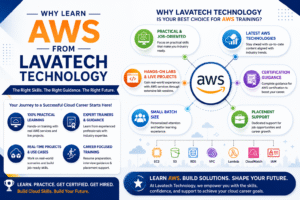
Lavatech Technology focuses on practical, career-oriented technical education.
For learners searching for the best AWS course in Kothrud, the training approach should ideally combine conceptual understanding, practical exercises, projects, and career preparation.
Lavatech Technology can position its AWS training around several important learning objectives:
Practical Learning
AWS is easier to understand when learners actually work with cloud resources.
Hands-on exercises can help students gain confidence with AWS services and cloud environments.
Industry-Relevant Skills
AWS training should focus on skills that are useful in modern cloud and IT environments.
The curriculum can include cloud infrastructure, Linux, networking, security, databases, automation, DevOps integration, and monitoring.
Project-Based Training
Projects give learners an opportunity to apply multiple AWS services together.
Instead of studying each service independently, learners can understand how services work as part of a complete architecture.
Certification Guidance
AWS certifications can help learners validate their knowledge.
Training can support certification preparation through:
- Concept revision
- Practice questions
- Service explanations
- Exam-oriented discussions
- Scenario-based learning
Certification preparation should complement practical learning rather than replace it.
Career-Oriented Learning
The objective of AWS training should be to help learners build skills that can be demonstrated during technical interviews and practical assessments.
Who Can Join the Best AWS Course in Kothrud?
AWS training is not limited to experienced cloud engineers.
Different groups can benefit from learning AWS.
Students
Students who want to enter the IT industry can build foundational cloud skills alongside their academic education.
AWS can complement:
- Computer science
- Information technology
- Software development
- Networking
- Linux
- DevOps
Freshers
Freshers can use AWS training to build practical skills that go beyond academic theory.
A portfolio containing cloud projects can help demonstrate practical understanding.
Developers
Developers can learn how applications are deployed, secured, scaled, and monitored in cloud environments.
System Administrators
System administrators can expand their traditional infrastructure knowledge into cloud administration and engineering.
DevOps Professionals
DevOps professionals can use AWS for:
- CI/CD
- Infrastructure automation
- Containers
- Monitoring
- Application deployment
- Infrastructure as Code
Working Professionals
Professionals who want to transition toward cloud-related roles can use structured AWS training to develop new technical capabilities.
Skills You Can Build Through AWS Training
A comprehensive AWS course can help learners develop several technical skills.
Cloud Infrastructure
Understand how computing, storage, networking, and databases operate in the cloud.
Linux
Learn how Linux systems are configured and managed on cloud servers.
Networking
Understand VPCs, subnets, routing, gateways, and security controls.
Security
Learn identity management, access policies, encryption concepts, and cloud security best practices.
Automation
Understand how repetitive infrastructure and deployment tasks can be automated.
Monitoring
Learn how applications and infrastructure can be monitored for performance and operational issues.
Troubleshooting
Develop the ability to investigate connectivity, permissions, deployment, and configuration problems.
These skills can provide a foundation for multiple cloud-related career paths.
Career Opportunities After AWS Training
AWS knowledge can support several technology career paths.
Depending on your existing skills, you may explore roles such as:
- AWS Cloud Engineer
- Cloud Administrator
- Cloud Support Engineer
- Cloud Solutions Architect
- DevOps Engineer
- Site Reliability Engineer
- Cloud Consultant
- Infrastructure Engineer
- Cloud Security Associate
- Systems Engineer
Job requirements vary by company and role. AWS training alone does not guarantee employment, but practical skills, projects, certifications, communication ability, and interview preparation can strengthen a candidate’s profile.
AWS Certification Preparation
Certification can be a useful way to demonstrate structured knowledge of AWS.
Popular certification paths include foundational, associate-level, professional-level, and specialty certifications.
Beginners may first explore foundational cloud knowledge before moving toward an appropriate certification.
Certification preparation should include:
- Understanding AWS concepts
- Learning important services
- Studying architecture principles
- Practicing scenario-based questions
- Reviewing security concepts
- Working on practical labs
- Taking practice assessments
- Revising weak areas
The most effective approach is to combine certification preparation with real AWS practice.
AWS Course in Pune for Beginners
Beginners often worry that AWS will be difficult because the platform contains many services.
The solution is to learn progressively.
A beginner-friendly learning path can follow this sequence:
Cloud Fundamentals → AWS Global Infrastructure → IAM → EC2 → S3 → VPC → Databases → Load Balancing → Auto Scaling → Monitoring → Serverless → DevOps Integration → Projects
This approach prevents learners from becoming overwhelmed.
The best AWS course in Kothrud for a beginner should explain concepts clearly and then reinforce them through practical exercises.
How to Choose the Best AWS Course in Kothrud
Before enrolling in any AWS training program, consider the following factors.
1. Curriculum
Check whether the course covers important AWS services and cloud fundamentals.
2. Practical Labs
Ask whether learners get opportunities to work directly with AWS.
3. Projects
Projects should combine multiple AWS services instead of focusing only on isolated demonstrations.
4. Trainer Expertise
Experienced trainers can explain practical use cases and common cloud challenges.
5. Updated Content
Cloud technology evolves continuously, so training material should remain relevant.
6. Career Preparation
Look for interview preparation, resume guidance, technical discussions, and project support where offered.
7. Learning Support
Access to doubt-solving and guidance can make the learning process easier.
8. Certification Guidance
If certification is your goal, check whether the course includes certification-oriented preparation.
Benefits of Learning AWS in Pune
Pune has a strong technology and education ecosystem, making cloud computing an attractive skill area for students and professionals.
Learning AWS in Pune can provide access to:
- Technical training
- IT learning communities
- Professional networking
- Cloud-focused career opportunities
- DevOps learning paths
- Software development ecosystems
- Technology-focused educational institutions
For learners in Kothrud and surrounding areas, choosing a structured local training program can also make regular classroom or instructor-led learning more convenient.
AWS + Linux + DevOps: A Powerful Combination
AWS knowledge becomes especially useful when combined with Linux and DevOps.
Consider a typical modern deployment workflow:
Developer → Git → CI/CD Pipeline → Docker → AWS Infrastructure → Monitoring
Each technology contributes something different.
Linux provides operating-system knowledge.
Git supports source-code management.
Docker provides application containerization.
CI/CD automates application delivery.
AWS provides cloud infrastructure.
Monitoring helps teams understand application and infrastructure performance.
Learning these technologies together can provide a broader understanding of modern IT operations.
AWS Learning Roadmap for Beginners
If you are starting from zero, follow a structured roadmap.
Step 1: Learn Cloud Computing
Understand the fundamental concepts first.
Step 2: Learn Linux Basics
Practice commands, files, permissions, processes, networking, and package management.
Step 3: Learn AWS Core Services
Start with:
- IAM
- EC2
- S3
- VPC
- RDS
- CloudWatch
Step 4: Practice Networking
Understand how subnets, routes, gateways, and security groups work.
Step 5: Build Projects
Create small projects and gradually increase complexity.
Step 6: Learn Automation
Explore CloudFormation, scripting, CI/CD, and DevOps practices.
Step 7: Prepare for Certification
Choose a suitable certification based on your career objective.
Step 8: Build a Portfolio
Document your projects and explain the architecture, technologies, problems, and solutions.
Common Mistakes AWS Beginners Should Avoid
Learning AWS can become confusing when beginners follow an unstructured approach.
Avoid these common mistakes:
Trying to Learn Every AWS Service
AWS has a huge service portfolio. Start with core services relevant to your goals.
Ignoring Networking
Networking is fundamental to cloud architecture.
Avoiding Hands-On Practice
Cloud skills require practice.
Memorizing Instead of Understanding
Focus on why a service is used and how it fits into an architecture.
Ignoring Security
IAM and security should be part of every AWS learning journey.
Skipping Projects
Projects help connect individual concepts.
Depending Only on Certification
Certification is valuable, but practical knowledge remains important.
Frequently Asked Questions About the Best AWS Course in Kothrud
1. What is the best AWS course in Kothrud?
The best AWS course in Kothrud should provide structured cloud learning, practical AWS labs, real-world projects, important AWS services, certification guidance, and career-focused support. Lavatech Technology offers AWS-focused training designed around practical and industry-oriented learning.
2. Is AWS difficult for beginners?
AWS can seem complex initially because it includes many services. However, beginners can learn effectively by starting with cloud fundamentals and gradually progressing through core services such as IAM, EC2, S3, VPC, and RDS.
3. Can freshers learn AWS?
Yes. Freshers can learn AWS by starting with cloud fundamentals and building practical projects. Basic Linux, networking, and programming knowledge can also be helpful.
4. Does AWS training include practical projects?
A career-oriented AWS program should include hands-on labs and projects. Practical exercises help learners understand how AWS services are configured and used.
5. Is AWS useful for DevOps?
Yes. AWS and DevOps are frequently used together for infrastructure automation, application deployment, CI/CD, containers, monitoring, and scalable cloud environments.
6. Can developers learn AWS?
Absolutely. Developers can learn AWS to deploy applications, use managed databases, build serverless applications, implement CI/CD pipelines, and understand cloud architecture.
7. Can working professionals learn AWS?
Yes. Working professionals can learn AWS to expand their existing IT skills or move toward cloud-oriented responsibilities.
8. Does AWS certification help with career development?
Certification can help demonstrate knowledge of AWS concepts. However, practical skills, projects, technical experience, and interview performance are also important.
9. What should I learn before AWS?
Beginners can start directly with cloud fundamentals. Basic Linux, networking, programming, or system administration knowledge can make some AWS topics easier.
10. Why choose Lavatech Technology for AWS training?
Lavatech Technology focuses on practical, structured, and career-oriented technical learning. AWS training can combine cloud fundamentals, core AWS services, hands-on exercises, projects, DevOps integration, and certification guidance.
Final Thoughts
AWS has become an important technology for modern cloud computing, application deployment, infrastructure management, and DevOps.
Whether you are a student, fresher, developer, system administrator, DevOps learner, or working IT professional, building AWS knowledge can expand your understanding of modern technology environments.
If you are searching for the best AWS course in Kothrud, focus on more than the course title. Look for a program that provides practical training, a structured curriculum, hands-on AWS labs, projects, cloud architecture concepts, security awareness, automation, and career-oriented guidance.
Lavatech Technology can help learners build their AWS foundation through a practical and structured learning approach.
The goal should not simply be to complete an AWS course. The goal should be to understand cloud technology well enough to build, deploy, manage, secure, monitor, and troubleshoot real-world cloud environments.
Start learning AWS, build practical cloud projects, strengthen your technical profile, and take the next step toward a cloud-focused IT career with Lavatech Technology.