
How a Pune Student Started a DevOps Career: From Linux to Cloud & DevOps – A Complete Journey
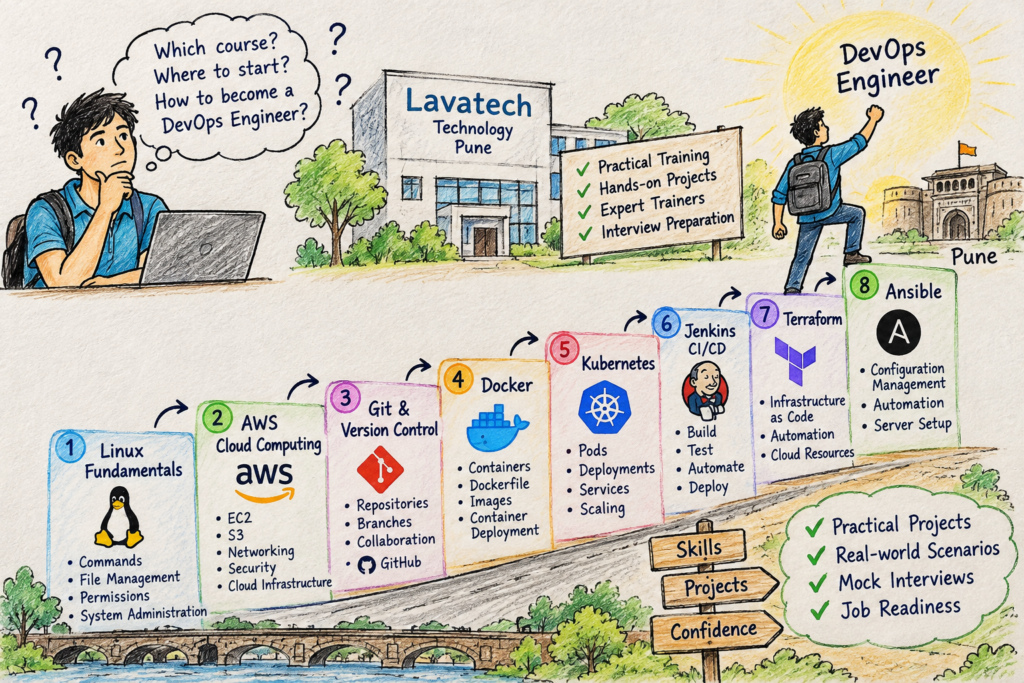
Looking for a DevOps Course in Pune but not sure where to start? This is the story of a student who started with basic IT knowledge and gradually built practical skills in Linux, Cloud Computing and DevOps.
Starting a career in DevOps can feel overwhelming.
You hear about Linux, AWS, Docker, Kubernetes, Jenkins, Terraform, Ansible, CI/CD and dozens of other technologies. The biggest question is often not what to learn, but where to start and how to learn everything in the right order.
This is the journey of one Pune student who decided to build his DevOps career step by step with Lavatech Technology, Pune.
The Beginning: A Student With a Career Goal
Like many students and IT professionals, he wanted to build a career in a technology field with strong practical demand.
He had basic IT knowledge and had heard about Cloud Computing and DevOps. He knew that companies were increasingly adopting cloud platforms, automation and container technologies.
But there was one problem.
He didn’t know how all these technologies were connected.
He could find hundreds of tutorials online about AWS, Docker, Kubernetes and Jenkins. But learning individual tools randomly was making things more confusing.
He needed a structured learning path.
While searching for a DevOps Course in Pune, he came across Lavatech Technology, a software training institute in Pune offering training in Linux, Cloud Computing and DevOps.
Instead of trying to learn everything at once, he decided to start from the fundamentals.
And that changed his learning journey.
Step 1: Building the Foundation With Linux
The first step was Linux.
For anyone planning a career in DevOps, Linux is an important foundation. Many servers, cloud environments and DevOps tools are built around Linux-based systems.
His initial focus was on understanding Linux fundamentals, including:
- Linux commands
- File and directory management
- Users and groups
- File permissions
- Processes
- Package management
- Services
- Networking basics
- Disk and filesystem management
- Shell commands
- Basic scripting
Commands such as chmod, chown, systemctl, ps, df, du and grep initially looked like simple commands to memorize.
But gradually, he understood what was happening behind those commands.
He learned how users interact with a Linux system, how services run, how permissions work and how administrators troubleshoot servers.
This became the foundation for his DevOps journey.
Step 2: Moving From Linux to Cloud Computing
Once his Linux fundamentals became stronger, he started asking another question:
How are these servers used in modern IT environments?
That led him to Cloud Computing.
He began learning AWS and understanding how organizations use cloud infrastructure instead of relying only on traditional physical servers.
His learning included concepts such as:
- Amazon EC2
- IAM
- VPC
- Subnets
- Security Groups
- EBS
- Load Balancing
- Auto Scaling
- S3
- Cloud networking
- Monitoring
This was an important stage in his journey.
Previously, a server was simply a machine.
Now he was learning how to create, configure, secure and manage infrastructure in the cloud.
The combination of Linux + AWS started giving him a clearer understanding of how modern infrastructure works.
Step 3: Learning Git and Version Control
The next step was Git.
He learned that DevOps is closely connected with the software development lifecycle.
Developers continuously make changes to application source code, and teams need a reliable way to track, manage and collaborate on those changes.
He started working with:
- Git
- GitHub
- Repositories
- Commits
- Branches
- Merging
- Pull and push operations
- Version control
He gradually understood how development teams collaborate and how source code becomes part of an automated deployment pipeline.
This was his introduction to the foundation of modern CI/CD workflows.
Step 4: Understanding Docker and Containers
Next came Docker.
Before learning Docker, he had heard the common phrase:
“It works on my machine.”
But he wanted to understand how applications could be packaged and moved consistently between environments.
Docker helped answer that question.
He started learning:
- Docker images
- Containers
- Dockerfiles
- Container networking
- Container storage
- Image registries
- Application deployment using containers
He began to understand why containers had become so important in modern application development and deployment.
More importantly, he started connecting Docker with the technologies he had already learned.
Linux → AWS → Git → Docker
The learning journey was becoming more connected.
Step 5: Entering the World of Kubernetes
After learning Docker, the next question was obvious:
What happens when an organization needs to manage hundreds or thousands of containers?
That led him to Kubernetes.
He started learning about:
- Pods
- Deployments
- Services
- ReplicaSets
- Namespaces
- ConfigMaps
- Secrets
- Kubernetes networking
- Application deployment
At first, Kubernetes seemed complicated.
But because he already understood Linux, Cloud and Docker, the concepts gradually became easier.
He began to understand that Kubernetes was not another isolated technology.
It was part of a larger ecosystem for managing containerized applications.
Step 6: Automating Deployment With Jenkins and CI/CD
The next challenge was automation.
Modern DevOps teams aim to reduce manual work and make software delivery faster and more reliable.
This introduced him to Jenkins and CI/CD.
He learned how a typical pipeline can connect different stages of software delivery:
Code → Build → Test → Package → Deploy
He explored concepts such as:
- Jenkins jobs
- Jenkins pipelines
- Git integration
- Build automation
- Continuous Integration
- Continuous Delivery
- Automated deployments
This was one of the most important moments in his journey.
He realized that DevOps is not simply about knowing many tools.
DevOps is about improving the entire software delivery and infrastructure process through collaboration, automation and continuous improvement.
Step 7: Infrastructure as Code With Terraform
As his understanding of Cloud and DevOps grew, he discovered another important concept:
Infrastructure as Code, or IaC.
Traditionally, cloud resources can be created manually through a cloud provider’s console.
But what happens when an organization needs to create the same infrastructure repeatedly?
That’s where Terraform becomes useful.
He started learning how infrastructure could be:
- Defined as code
- Version controlled
- Reused
- Modified
- Automated
Terraform helped him understand how modern DevOps teams manage cloud infrastructure consistently and efficiently.
Step 8: Automating Configuration With Ansible
The next part of his journey was Ansible.
Managing one server manually might be manageable.
Managing dozens or hundreds of servers manually is a different story.
Ansible introduced him to configuration management and automation.
He learned how repetitive tasks could be automated across multiple systems.
This reinforced one of the most important DevOps principles:
Automate repetitive tasks whenever possible.
Step 9: Connecting Everything Through Practical Projects
Learning technologies individually was useful.
But the real transformation happened when he started connecting them.
Instead of looking at Linux, AWS, Git, Docker, Kubernetes and Jenkins as separate subjects, he started seeing them as parts of a single workflow.
For example:
Developer → Git → Jenkins → Docker → Kubernetes → AWS
Infrastructure could be managed using:
Terraform → AWS Infrastructure
Configuration and repetitive tasks could be automated using:
Ansible → Servers
Now the technologies were starting to make sense together.
This practical approach was an important part of his learning experience at Lavatech Technology.
Step 10: Preparing for DevOps Interviews
Technical knowledge is only one part of becoming job-ready.
The student also needed to learn how to explain his knowledge during technical interviews.
His preparation included scenario-based questions related to:
- Linux troubleshooting
- AWS
- Cloud networking
- Docker
- Kubernetes
- Jenkins
- CI/CD
- Terraform
- Ansible
- Infrastructure
- Deployment failures
- Production troubleshooting
For example, instead of simply memorizing:
“How do you increase an EBS volume?”
he learned to think through the complete troubleshooting process.
Similarly, instead of memorizing Kubernetes commands, he learned how to approach situations where a pod is failing or an application is not accessible.
This scenario-based preparation helped him become more confident when discussing technical problems.
What Changed During His DevOps Journey?
At the beginning, he knew the names of several technologies.
AWS.
Docker.
Kubernetes.
Jenkins.
Terraform.
Ansible.
But knowing technology names is not the same as understanding them.
After following a structured learning path, he started understanding how everything connected.
Linux
Provided the foundation for server administration.
AWS
Provided cloud infrastructure.
Git
Provided version control.
Docker
Provided application containerization.
Kubernetes
Provided container orchestration.
Jenkins
Provided CI/CD automation.
Terraform
Provided Infrastructure as Code.
Ansible
Provided configuration and automation.
Together, these technologies created a much clearer picture of the modern DevOps ecosystem.
Why a Structured DevOps Course Matters
One of the biggest lessons from this journey is that learning DevOps randomly can create unnecessary confusion.
A beginner may start with Kubernetes today, Docker tomorrow and Terraform the next day.
Without understanding the fundamentals, the tools can appear disconnected.
A structured DevOps Training in Pune can help learners progress logically:
Linux → Networking → Cloud → Git → Docker → CI/CD → Kubernetes → Terraform → Ansible
Each stage builds on the previous one.
This approach makes complex technologies easier to understand.
Why Lavatech Technology?
For students searching for a DevOps Course in Pune, the choice of training institute matters.
The goal should not simply be to complete a syllabus.
Students should look for a learning environment where they can build:
- Strong Linux fundamentals
- Cloud knowledge
- DevOps tool expertise
- Automation skills
- Troubleshooting ability
- Hands-on experience
- Project experience
- Interview confidence
Lavatech Technology, Pune focuses on Linux, Cloud Computing and DevOps technologies with an emphasis on practical learning and career preparation.
For students looking for DevOps Training in Pune, a structured learning approach can make it easier to understand how individual tools fit into the larger DevOps lifecycle.
Can Beginners Learn DevOps?
Yes.
DevOps may look complicated because it involves multiple technologies, but beginners do not need to learn everything simultaneously.
A better approach is to build the foundation first.
Start with:
Linux
Then learn:
Networking + Cloud
Then:
Git + Docker
Then:
CI/CD + Kubernetes
And finally:
Terraform + Ansible + Automation
Consistent hands-on practice is more valuable than trying to finish ten technologies in a few weeks.
Is Certification Enough for a DevOps Job?
Certifications can demonstrate knowledge, but practical skills are extremely important.
During a DevOps interview, a candidate may be asked:
- How would you troubleshoot a Linux server?
- How does a Kubernetes deployment work?
- How would you troubleshoot a failed Jenkins pipeline?
- How would you deploy an application using Docker?
- How would you provision AWS infrastructure using Terraform?
- How would you troubleshoot an application that is not accessible?
- How would you automate server configuration using Ansible?
These questions require understanding and problem-solving skills.
That is why hands-on practice should be an important part of a DevOps Course in Pune.
The Complete DevOps Career Learning Path
The student’s journey can be summarized into ten stages:
1. Linux Fundamentals
Build a strong foundation in Linux and system administration.
2. Networking
Understand IP addresses, ports, DNS, HTTP, firewalls and networking fundamentals.
3. Cloud Computing
Learn AWS infrastructure and cloud concepts.
4. Git and GitHub
Understand version control and collaboration.
5. Docker
Learn application containerization.
6. Kubernetes
Learn container orchestration and application deployment.
7. Jenkins and CI/CD
Automate software build, testing and deployment.
8. Terraform
Learn Infrastructure as Code.
9. Ansible
Automate configuration and repetitive infrastructure tasks.
10. Projects and Interview Preparation
Apply the knowledge through practical projects and scenario-based interview preparation.
Start Your DevOps Journey in Pune
Every DevOps professional starts somewhere.
For this student, the journey started with a simple question:
“How can I build a career in DevOps?”
The answer was not to learn every DevOps tool at once.
It was to build the right foundation and move forward step by step.
From Linux to AWS Cloud, from Git to Docker, from Kubernetes to Jenkins, and from Terraform to Ansible, every technology became another piece of the larger DevOps picture.
For students searching for a DevOps Course in Pune, Lavatech Technology offers a structured environment to learn Linux, Cloud Computing and DevOps technologies while developing practical skills and preparing for technical interviews.
Your DevOps career does not have to start with knowing everything.
It can start with learning one technology properly.
Start with Linux. Learn Cloud. Practice DevOps. Build projects. Prepare for interviews.
And most importantly, learn how the technologies work together.
Your DevOps journey can start today.
Frequently Asked Questions
What is the best DevOps Course in Pune?
The right course should provide a structured learning path covering Linux, Cloud Computing, Git, Docker, Kubernetes, CI/CD, Terraform and Ansible, along with practical training and interview preparation.
Can a beginner learn DevOps?
Yes. Beginners can start with Linux and networking fundamentals and gradually move toward Cloud, Docker, Kubernetes, CI/CD and automation.
Is Linux important for DevOps?
Yes. Linux is an important foundation because many servers, cloud environments and DevOps tools operate in Linux-based environments.
Do I need programming experience to learn DevOps?
Advanced programming knowledge is not mandatory to start. However, basic scripting and automation skills can be very useful for DevOps professionals.
Why is practical training important for DevOps?
DevOps involves infrastructure, automation, deployment and troubleshooting. Hands-on practice helps learners understand how technologies work in real-world scenarios.
Where can I learn DevOps in Pune?
Students looking for DevOps Training in Pune can explore institutes such as Lavatech Technology, compare their curriculum, practical training, learning methodology and career-support offerings, and choose the program that matches their career goals.