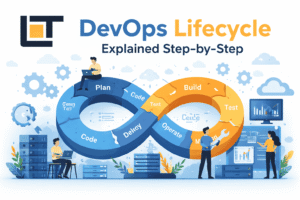
DevOps Lifecycle Explained Step-by-Step: A Complete Guide by Lavatech Technology
In today’s fast-paced software industry, organizations must deliver applications faster, more reliably, and with fewer errors. Traditional development and operations models often created silos, delays, and inefficiencies. This is where the DevOps Lifecycle Explained Step-by-Step approach becomes essential for modern IT teams.
DevOps is a powerful combination of development (Dev) and operations (Ops) practices that enables continuous integration, delivery, monitoring, and collaboration throughout the software development process. Understanding the DevOps lifecycle helps businesses achieve faster releases, improved quality, and seamless automation.
In this complete guide by Lavatech Technology, we explain each stage of the DevOps lifecycle in a simple, practical, and structured manner.
For more information. Click here lavatechtechnology.com
What is DevOps Lifecycle?
The DevOps lifecycle is a continuous process that integrates software development, testing, deployment, and monitoring using automation and collaboration. It ensures that software is developed, tested, and delivered efficiently with minimal risk.
Unlike traditional models, DevOps follows an iterative and continuous cycle, meaning improvements happen constantly rather than in isolated phases.
DevOps Lifecycle Explained Step-by-Step
1. Planning Phase
The lifecycle begins with planning. In this stage, teams define project goals, features, timelines, and requirements. Collaboration between developers, operations teams, and stakeholders ensures alignment from the beginning.
Common tools: Jira, Azure Boards
Benefits:
Clear roadmap
Better collaboration
Reduced project failure risk
2. Development Phase
Developers write and manage code based on requirements defined in planning. Version control systems help teams collaborate efficiently and track changes.
Common tools: Git, GitHub, GitLab
Benefits:
Faster coding cycles
Efficient version management
Team collaboration
3. Continuous Integration (CI)
In this stage, developers frequently merge code into a shared repository. Automated builds and tests run continuously to detect issues early.
Common tools: Jenkins, GitHub Actions, GitLab CI
Benefits:
Early bug detection
Stable codebase
Faster development
4. Testing Phase
Automated and manual testing ensures software quality. Tests include functional, performance, security, and integration testing.
Common tools: Selenium, JUnit, TestNG
Benefits:
Improved software quality
Reduced production failures
Higher user satisfaction
5. Deployment (Continuous Deployment/CD)
After successful testing, applications are deployed automatically to staging or production environments. This eliminates manual errors and speeds up releases.
Common tools: Docker, Kubernetes, Ansible
Benefits:
Faster release cycles
Reliable deployments
Scalable infrastructure
6. Monitoring and Feedback
Once deployed, applications are continuously monitored for performance, availability, and errors. Feedback is collected to improve future releases.
Common tools: Prometheus, Grafana, ELK Stack
Benefits:
Real-time issue detection
Performance optimization
Continuous improvement
Why DevOps Lifecycle is Important for Businesses
Understanding the DevOps Lifecycle Explained Step-by-Step helps organizations achieve:
Faster software delivery
Higher deployment success rates
Improved collaboration
Reduced downtime
Better customer experience
Companies adopting DevOps often see a dramatic improvement in productivity and software reliability.
DevOps Lifecycle in Real-World Industry
In modern IT companies, DevOps lifecycle automation enables multiple deployments per day with minimal risk. Startups and enterprises alike use DevOps practices to stay competitive in digital transformation.
Without DevOps, organizations face slow releases, communication gaps, and inefficient processes — a serious negative impact on business agility.
Learn DevOps Lifecycle at Lavatech Technology
At Lavatech Technology, our DevOps training program covers the complete DevOps lifecycle with real-time projects and industry tools. Students gain practical experience in CI/CD pipelines, containerization, automation, and monitoring.
Our expert trainers ensure learners understand DevOps concepts step-by-step and become job-ready professionals in the IT industry.
Conclusion
The DevOps Lifecycle Explained Step-by-Step approach provides a structured and continuous framework for building, testing, deploying, and monitoring software efficiently. By integrating automation, collaboration, and continuous improvement, DevOps helps organizations deliver high-quality applications faster than ever.
For aspiring IT professionals, mastering the DevOps lifecycle is a powerful career advantage in today’s technology-driven world.
For more information. Click here lavatechtechnology.com
Call us on +91 9607331234