Amazing DevOps Course in Katraj with AWS, Docker, Kubernetes and Terraform Training 2026
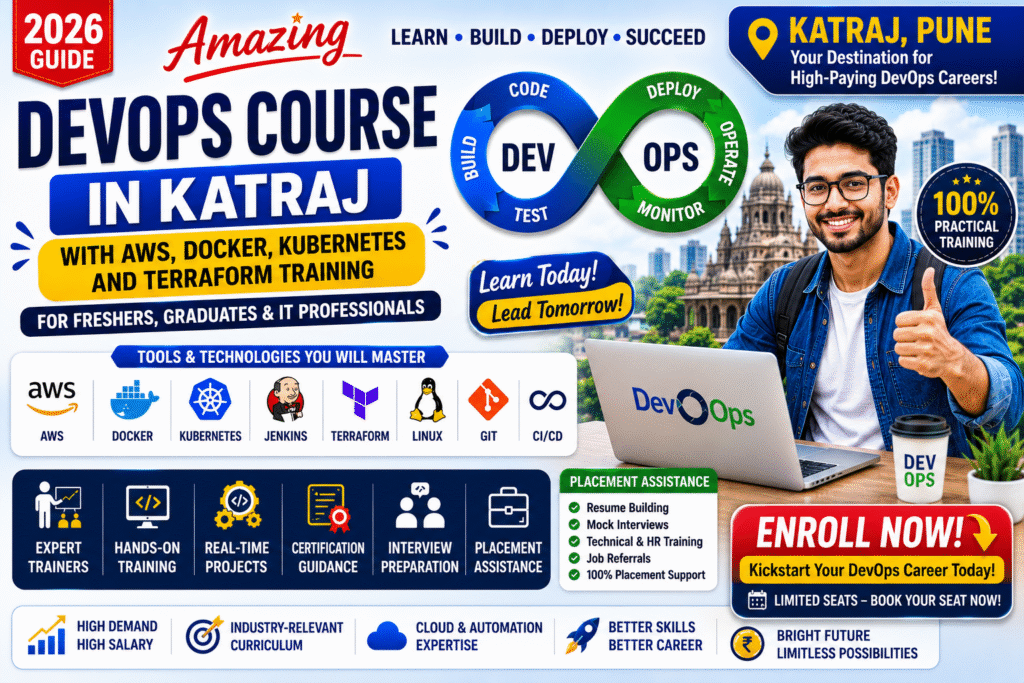
The modern IT industry is rapidly embracing cloud computing, automation, and continuous delivery practices. Organizations are actively seeking professionals who can manage cloud infrastructure, automate deployments, and improve software delivery pipelines. This demand has made DevOps one of the fastest-growing and highest-paying career paths in the technology sector.
If you are looking to build a future-proof career in cloud computing and automation, joining a DevOps Course in Katraj can be a smart decision. With hands-on training in AWS, Docker, Kubernetes, Terraform, Jenkins, Linux, Git, and CI/CD, learners gain practical skills that are highly valued by employers.
Whether you are a fresher, graduate, software developer, system administrator, or IT professional, this training program can help you develop job-ready expertise and accelerate your career growth in 2026.
Why Choose a DevOps Course in Katraj?
Katraj is one of Pune’s rapidly developing educational hubs and offers easy access to major IT destinations such as Hinjewadi, Baner, Kharadi, and Magarpatta. Students and professionals can conveniently attend training while staying connected to Pune’s thriving technology ecosystem.
Benefits of Joining a DevOps Course in Katraj
- Industry-oriented curriculum
- Real-time practical projects
- Placement assistance
- Interview preparation
- Flexible batch timings
- Certification guidance
- Experienced trainers
- Hands-on cloud training
A professional DevOps Course in Katraj focuses on practical implementation rather than theoretical concepts, helping learners become industry-ready.
What is DevOps?
DevOps combines Development and Operations to improve collaboration between software development and IT operations teams.
The primary objectives of DevOps include:
- Continuous Integration (CI)
- Continuous Deployment (CD)
- Infrastructure Automation
- Faster Software Delivery
- Improved Application Quality
- Better Team Collaboration
- Reduced Downtime
DevOps practices help organizations deliver reliable software quickly and efficiently.
Technologies Covered in the ccccc
Linux Administration
Linux forms the foundation of cloud computing and DevOps environments.
Topics Covered
- Linux Commands
- User Management
- File Systems
- Networking
- Shell Scripting
- Process Management
Strong Linux skills are essential for managing servers and cloud infrastructure.
Git and GitHub
Git is the industry-standard version control system used by development and DevOps teams.
Modules Included
- Git Basics
- Repository Management
- Branching Strategies
- Merging
- Pull Requests
- GitHub Collaboration
Git helps teams track code changes and collaborate effectively.
AWS Cloud Training
Amazon Web Services (AWS) is one of the most widely used cloud platforms globally.
AWS Services Covered
- EC2
- S3
- IAM
- VPC
- Route 53
- CloudWatch
- Load Balancer
- Auto Scaling
- RDS
AWS expertise significantly improves career opportunities in cloud engineering and DevOps.
Docker Containerization
Docker allows developers to package applications and dependencies into lightweight containers.
Docker Topics
- Docker Installation
- Images and Containers
- Docker Compose
- Networking
- Volumes
- Container Deployment
Docker simplifies application deployment and ensures consistency across environments.
Kubernetes Training
Kubernetes is the leading container orchestration platform used by organizations worldwide.
Kubernetes Modules
- Pods
- Deployments
- Services
- ConfigMaps
- Secrets
- Namespaces
- Ingress
- Cluster Administration
Kubernetes skills are among the most in-demand competencies for DevOps professionals.
Jenkins CI/CD
Jenkins automates software building, testing, and deployment.
Jenkins Training Includes
- Jenkins Installation
- Pipeline Creation
- Continuous Integration
- Continuous Deployment
- Build Automation
- Plugin Management
Jenkins helps organizations achieve faster and more reliable software releases.
Terraform Infrastructure as Code
Terraform enables Infrastructure as Code (IaC), allowing cloud resources to be managed through code.
Terraform Topics
- Providers
- Resources
- Variables
- Modules
- State Management
- Cloud Infrastructure Automation
Terraform simplifies cloud infrastructure provisioning and management.
Real-Time Projects Included
Practical learning is one of the most important aspects of a successful DevOps Course in Katraj.
Project 1: AWS Cloud Infrastructure Deployment
Deploy and manage scalable cloud resources using AWS.
Project 2: Docker Containerization
Package and deploy applications using Docker containers.
Project 3: Kubernetes Cluster Management
Deploy and manage applications within Kubernetes environments.
Project 4: Jenkins CI/CD Automation
Create automated deployment pipelines for modern applications.
Project 5: Terraform Infrastructure Automation
Automate cloud infrastructure provisioning using Infrastructure as Code principles.
These projects help learners gain hands-on experience with real-world DevOps environments.
Placement Assistance and Career Support
A quality DevOps training program should include career development support.
Placement Assistance Includes
- Resume Building
- LinkedIn Profile Optimization
- Mock Interviews
- Technical Interview Preparation
- HR Interview Guidance
- Career Counseling
- Job Referrals
These services improve employability and help learners confidently approach interviews.
Common DevOps Interview Questions
Linux
- What is a Linux process?
- Explain Linux file permissions.
Git
- What is Git Rebase?
- Difference between Merge and Rebase?
Docker
- Difference between Docker Image and Container?
- What is Docker Compose?
Kubernetes
- What is a Pod?
- Explain Kubernetes Deployment.
AWS
- What is EC2?
- What is Auto Scaling?
Jenkins
- What is CI/CD?
- Explain Jenkins Pipeline.
Terraform
- What is Infrastructure as Code?
- What is Terraform State?
Preparing these questions helps students perform confidently during technical interviews.
Career Opportunities After Completing the DevOps Course in Katraj
After completing a DevOps Course in Katraj, learners can pursue various high-demand career paths.
Popular Job Roles
- DevOps Engineer
- AWS Cloud Engineer
- Site Reliability Engineer (SRE)
- Infrastructure Engineer
- Platform Engineer
- Automation Engineer
- Cloud Support Engineer
- Linux Administrator
- Release Engineer
As cloud adoption continues to increase, organizations actively seek professionals with DevOps expertise.
Why Choose Lavatech Technology?
Lavatech Technology offers practical, industry-oriented DevOps training designed to help learners become job-ready.
Key Advantages
- Experienced Industry Trainers
- Real-Time Projects
- Placement Assistance
- Interview Preparation
- AWS, Docker, Kubernetes & Terraform Training
- Certification Guidance
- Flexible Batch Options
- Hands-On Lab Environment
The training methodology focuses on practical implementation and real-world project experience.
Future Scope of DevOps in 2026
DevOps continues to be one of the most promising technology domains worldwide.
Emerging Career Areas
- Cloud Engineering
- DevSecOps
- Kubernetes Administration
- Platform Engineering
- Infrastructure Automation
- Site Reliability Engineering
- AI-Powered Operations
Professionals with expertise in AWS, Docker, Kubernetes, Terraform, and automation technologies can expect excellent career growth opportunities.
Conclusion
The Amazing DevOps Course in Katraj with AWS, Docker, Kubernetes and Terraform Training 2026 is an excellent opportunity for anyone looking to build a successful career in cloud computing, automation, and infrastructure management.
By mastering Linux, Git, AWS, Docker, Kubernetes, Jenkins, Terraform, and CI/CD through real-time projects and hands-on practice, learners gain valuable industry-ready skills. Combined with placement assistance, interview preparation, and certification guidance, a DevOps Course in Katraj can help you achieve long-term success in the rapidly growing IT industry.
FAQs
1. Is this DevOps course suitable for beginners?
Yes, beginners can start with Linux, networking, and cloud fundamentals before progressing to advanced DevOps tools.
2. Will I learn AWS, Docker, Kubernetes, and Terraform?
Yes, these technologies form a major part of the curriculum.
3. Does the course include real-time projects?
Yes, students work on practical projects involving cloud deployment, containerization, CI/CD, and infrastructure automation.
4. Is placement assistance provided?
Yes, placement support includes resume building, mock interviews, and job referrals.
5. Can working professionals join this course?
Yes, flexible batch schedules are available for working professionals.
6. What is the duration of the course?
Most DevOps programs range between 2 and 6 months depending on the curriculum.
7. What job roles can I apply for after completion?
You can apply for roles such as DevOps Engineer, AWS Cloud Engineer, SRE, Infrastructure Engineer, and Platform Engineer.
8. Why is DevOps a good career choice in 2026?
DevOps remains one of the most in-demand IT domains because organizations increasingly rely on cloud computing, automation, and continuous software delivery practices.